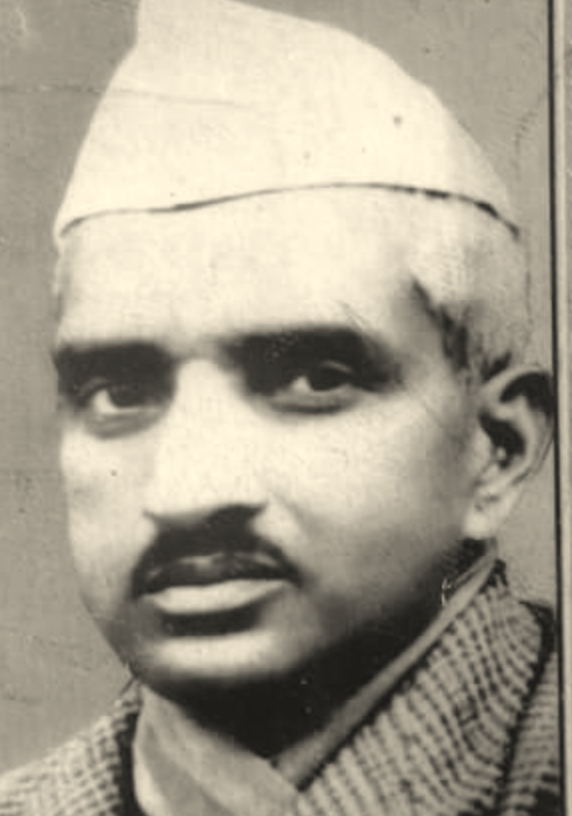
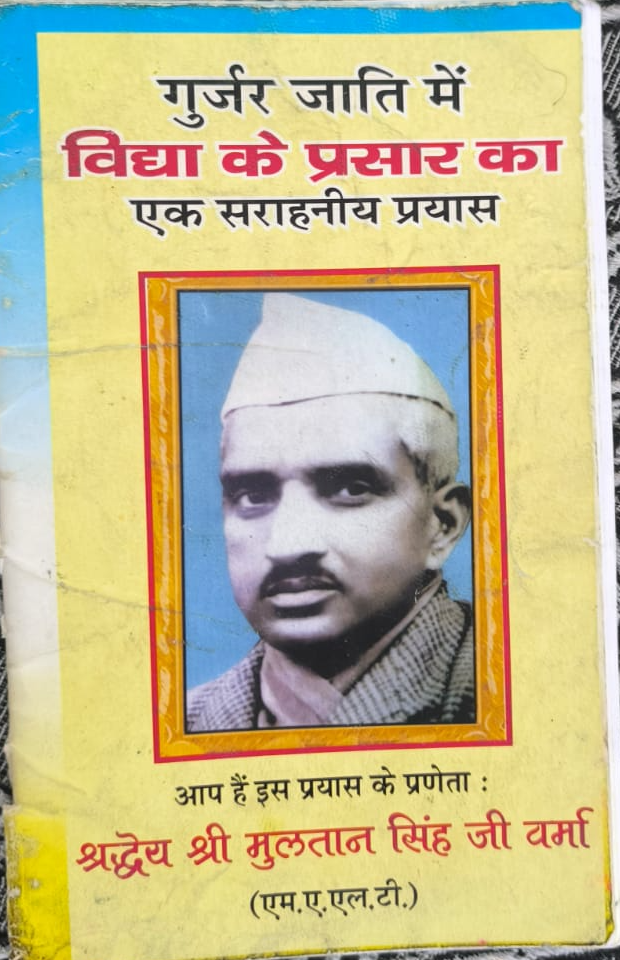
Halftone reproduction from the booklet cover. Original photograph not traced. MSV-ARCH-PHO-001
Documentary Archive · Established 2026
Chaudhary Multan Singh Varma His life and contribution
Born 12 August 1900 in the village of Naugavan, Tehsil Behat, District Saharanpur; died 16 January 1983. In a district where no boy from his community attended school, he began by getting himself educated, and spent the rest of his working life building educational institutions at Rampur Maniharan.
This is a documentary record of that work — papers, photographs, press cuttings and oral testimony, each item shown with its source.
Anything presented here as historical fact rests on a document, not on family memory or assertion. Where records disagree, both readings are shown. Where the evidence is insufficient, that is stated plainly. This is why the Claims section tests disputed statements against original records rather than repeating them.
Order of evidence: contemporary original record → government or institutional record → press report → later publication → oral account. Method
01
What he was trying to do
His vision
A list of institutions does not explain why they were built. In this rural part of Saharanpur in the early twentieth century, access to higher education was narrow; for children of cultivating families, even reaching the middle examination depended on a scholarship and someone's patronage.
His answer was not to take a post but to build an institution — funded by community subscription and donated land, teaching agriculture and science, and able to outlast him.
Contribution 01
Founding institutions
Schools and a college for Rampur Maniharan and the villages around it.
Contribution 02
Higher education for village students
Scholarships and hostels, without which study was not possible at all.
Contribution 03
Agriculture and science teaching
A practical curriculum for a district that lived by farming.
Contribution 04
A community-funded structure
Land, subscription and management, drawn from many contributors.
02
Chronology
7 of the recorded entries
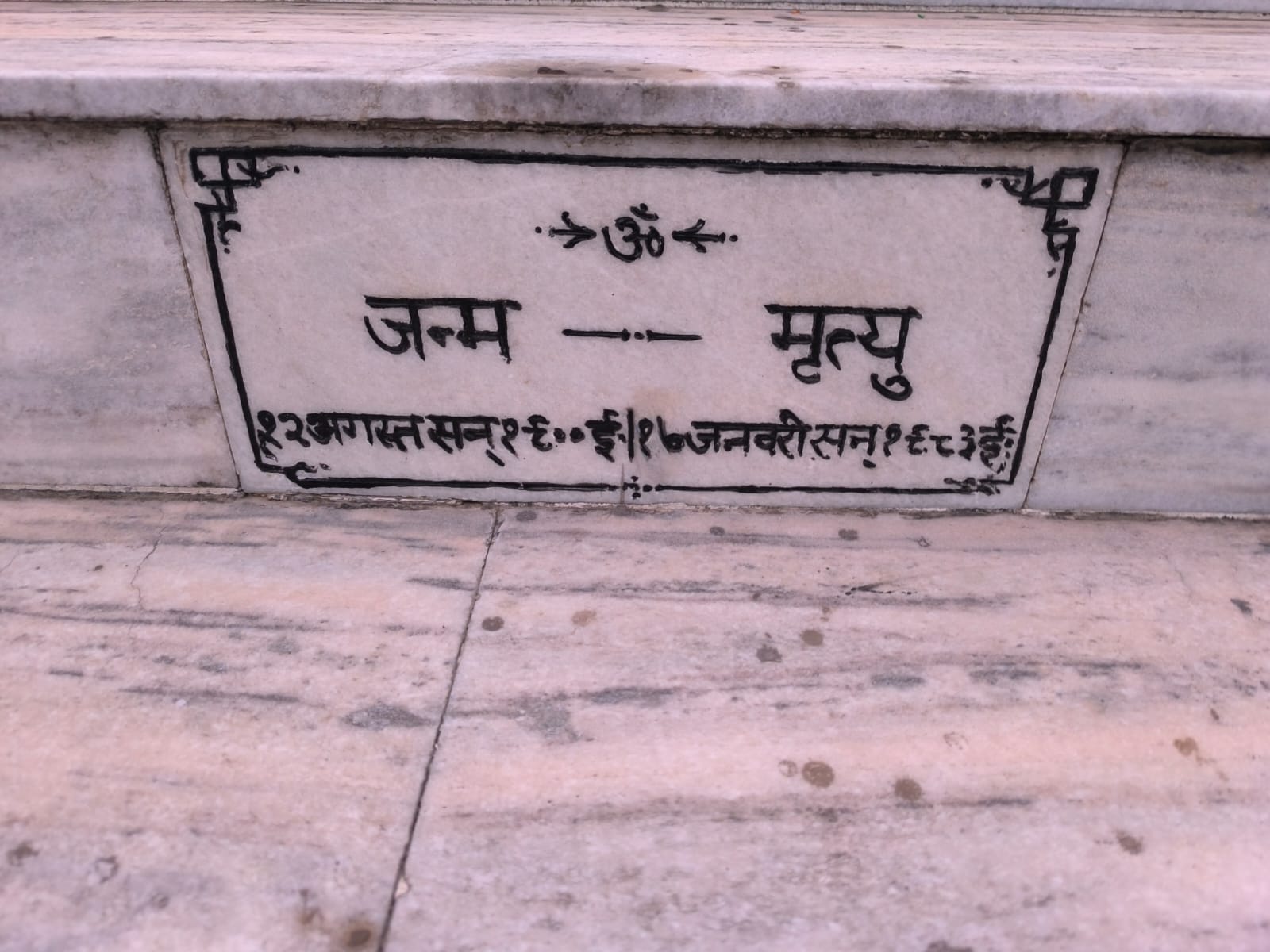
12 Aug 1900Born at Naugavan, Tehsil Behat, District Saharanpur. Father Chaudhary Shriram, mother Shrimati Karmvati. The booklet instead gives 1897.
Inscription · decisive
1917Passed high school at Muzaffarnagar — by the booklet's account the only Gujar student to do so that year, a claim whose scope it does not define. Entered Meerut College.
One source only
1919–1926Two earlier attempts at a school, at Saharanpur and then Rampur Maniharan, both of which ended. Furniture and library books were stored at Ch. Jaimal Singh's house.
One source only
13 June 1943Gujar Vidya Pracharini Sabha, Muzaffarnagar–Saharanpur Circle founded at his house in Nai Mandi; registered under the Societies Registration Act within a month.
Two sources agree
21 Sept 1943Shrimati Pirani Devi and Ch. Bharat Singh registered 159 bighas 15 biswas of land in the Sabha's name at Deoband.
One source only
1 Nov 1943Gujar Anglo Vedic School opened at Rampur Maniharan with twelve names entered and three temporary teachers.
Two sources agree
16 Jan 1983Died. The statue in the college grounds was unveiled a little over a year later, on 2 April 1984.
Inscription · decisive
Editorial note
The two sources differ on the year of birth by three years. The date carved on the statue is the one used here; the booklet's reading has not been erased. Every such conflict is recorded in one place on the References page.
03
Principal records
Featured documents
MSV-ARCH-PUB-001 · Later publication · 1982
Shri Multan Singh Varma ji ki Sankshipt Jeevani
By Om Prakash Gandhi, lecturer in geography at Gochar Krishi Inter College. Printed by Chaudhary Printing Press, Rampur Maniharan. First edition 1982; reissued 2023 and 2024.
MSV-ARCH-MON-001 · Monument record · 1984
Statue and inscriptions, Gochar Mahavidyalaya
Three marble plaques carved by the institution after his death. Independent of the booklet, and the deciding source for the dates of birth and death. Full text
Scan awaited Registration and land records
MSV-ARCH-1943-001 · Sought
Sabha registration and the Deoband registry
Society registration papers, the early resolutions, and the land registry and khatauni. Being sought. If you hold any of it
5 Sept 2026All three statue inscriptions transcribed (MON-001) — the first source in this archive independent of the booklet, and now the deciding record for the dates of birth and deathMonument
5 Sept 2026Booklet page 18 read in full: the illegible row proved to be Pirani Devi's description, not a separate donor. Printed totals do not reconcile; recorded as printedPublication
5 Sept 2026Pages 2 and 3 transcribed — the preface establishes that the booklet was written from Varma's own account, and that its author declined to call it free of errorPublication
4 Sept 2026Booklet pages 4–31 entered into the archive; halftone reproduction of the cover portrait recorded while the original photograph is soughtPublication
Do you hold an old paper or photograph?
Certificates, invitations, a prospectus, college magazines, letters, press cuttings, or photographs in which people remain unidentified — all of it is useful. Material is examined before anything from it is presented as historical fact, and the source is credited in the record.
Anyone, including present officers of the institution, may correct what is recorded here by producing documentary evidence. Corrections are logged publicly.