Biography
Chaudhary Multan Singh Varma
A record-based account of his life. Where no record exists, nothing has been inferred — the section is left open and the material still being sought is named.
- Born
- 12 August 1900
The booklet gives Jyeshtha badi doj, Samvat 1954 — that is, 1897 - Birthplace
- Village Naugavan, mauza Begupur, Tehsil Behat, District Saharanpur
- Parents
- Chaudhary Shriram and Shrimati Karmvati, of Chhapar Bataran
- Field of work
- Building educational institutions at Rampur Maniharan and in District Saharanpur
- Died
- 16 January 1983
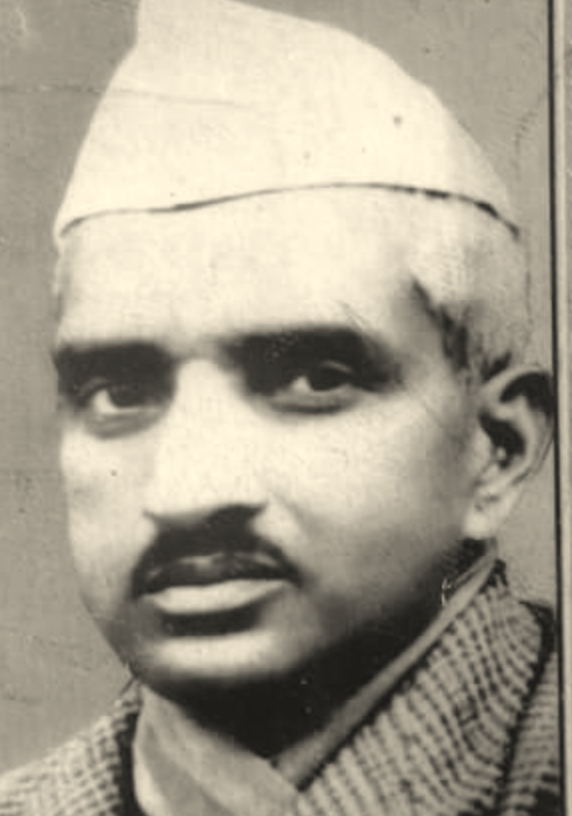
MSV-ARCH-PHO-001
Status of this page
This account rests on two sources: the inscriptions on his statue, and a booklet written from inside the institution in 1982. They differ on the year of birth by three years; the inscribed date is used here and the booklet's reading has not been erased. Society resolutions, registration papers, the Deoband registry and khatauni, board results, university correspondence, press cuttings, family papers and the testimony of contemporaries are all still being collected — as each arrives, the evidential standing of these statements will change here, whether it confirms or contradicts. Sources and conflicts · Method
Early life
Naugavan lies about six kilometres north of the town of Behat. At the time a padha taught children at Chaudhary Shriram's sitting place in the village, and the District Board also ran a primary school up to class four. According to the booklet, no boy of his community attended either.
The boy's assigned work was grazing the cattle. At the age of six or seven, on his own initiative, he began sitting with the padha for half an hour or an hour a day — the first boy of his community in the village to sit down to study. Some time later he fell seriously ill and was returned to work at home.
His uncle Chaudhary Shivraj enrolled him at the District Board primary school, where he passed class four in 1910.
Family
He was the eldest son of Chaudhary Shriram. Sarjit, Todar and Surat Singh were his three younger brothers, and Chameli a younger sister — five siblings in all.
Marriage
While he was studying for his intermediate at Meerut he was married to a girl from the village of Kunja, near Churiyala. His wife died in 1924. In 1926 he married again, to Shrimati Malkhani Devi of Babupur Nagli.
Records sought
The booklet does not give his first wife's name, the year of the marriage, or details of children. Sought: family papers, wedding invitations, a genealogical record.
Education
After class four he sat the scholarship examination and was awarded two rupees a month, tied to Kailashpur Town School, Saharanpur. The school was some 25 kilometres from Naugavan, so living in the hostel became unavoidable; boarding-house fees were eight annas, and pulses and flour went from home. On this support he passed class six, and at the next scholarship examination the award rose to three rupees a month.
At that time class six was followed by junior special and senior special before the middle examination, which meant going to Saharanpur or Muzaffarnagar. Three rupees a month made this difficult, and the family was not in a position to meet the cost of study. It was in these circumstances that he came to the notice of Pradhan Maharaj Singh Varma of Mundlana, District Saharanpur, whose support made further education possible.
Muzaffarnagar
At the school in Muzaffarnagar he passed the junior and senior special classes and, in 1915, the middle English examination. He also succeeded in the high school scholarship examination, receiving six rupees a month, and the Mahasabha sanctioned a further six rupees a month. He passed the high school examination in 1917.
Throughout his time at Muzaffarnagar he lived in the Jat Boarding House, where he acquired the observances of the Arya Samaj — sandhya and havan. The booklet measures the educational condition of that year in a single sentence: he was the only Gujar student to pass high school that year.
Meerut
After high school in 1917 he wanted to join the overseer course at Thomson Engineering College, Roorkee. His companion Genda Prakash reported that at Chaudhary Mamraj Singh's house in Shamli, Pradhan Maharaj Singh had been saying that Multan Singh should be sent to college. He wrote to the Pradhan at once; the reply came by telegram — "You will have to join College". He gave up the idea of becoming an overseer.
Correspondence with Agra College and Mayer College, Allahabad followed, through the headmaster of Government High School, Muzaffarnagar. Allahabad wired "No Vacancy", Agra "Vacancy in Arts only" — and he wanted to read science. Having no alternative, he enrolled at Meerut College.
The Mahasabha's fixed scholarship was not enough to live on, and the family could not meet the remaining cost. He wrote to Pradhan Maharaj Singh and received the reply — "The Sabha will bear the whole expense." According to the booklet, the Sabha went on paying his actual bills.
Meerut then held the only college in the Meerut commissionery. A rented Gujar hostel ran there under a monitor, Ranjit Singh of Bonda, but it was far from the college, so he stayed in the college hostel instead. He had played football, kabaddi and hockey since high school, and was in Meerut College's first teams.
Banaras
Shri Bhikkhan Lal Atreya of Judda, who had studied with him at Muzaffarnagar from the junior special class onward, had gone on to Banaras Hindu University. At his urging Multan Singh decided to enrol there too. At about this time Pradhan Maharaj Singh made his wish plain: he wanted him to run a Gujar school. Deferring to it, he took admission at Banaras and — since running a school required English — dropped science for English, economics and philosophy. The university had been founded by Pandit Madan Mohan Malaviya.
Influences
The clearest influence is Pradhan Maharaj Singh. According to the booklet he was born in 1886 at village Mundlana, District Saharanpur; through satsang he came under the deep influence of Rishi Dayanand, and by the age of twenty-two was known within the community as a reformer.
He took the leading part in founding the Shrimati Dharmarakshini Gujar Kshatriya Mahasabha, Bharatvarsh. The Mahasabha brought out a monthly, Gujar Hitkari, edited by Munshi Kadam Singh of Gangoh, and established a fund from which scholarships were given to poor students.
Seeing his name in the middle examination gazette, Pradhan Maharaj Singh wrote to the headmaster of Kailashpur school, Shri Mohammad Hasan, that Multan Singh was being given a scholarship of four rupees a month to continue his studies. Shri Hasan sent word on to Chaudhary Shriram at Naugavan. That was his first introduction to Pradhan Maharaj Singh. Booklet, page 7, in summary
Pradhan Maharaj Singh died at the age of thirty-seven. The booklet records that Multan Singh Varma always held his mission in mind and worked to complete it.
Two further influences appear in the booklet: the Arya Samaj observances he took up at the Jat Boarding House in Muzaffarnagar, and Shri Bhikkhan Lal Atreya of Judda, at whose urging he went to Banaras Hindu University.
Entry into public work
He passed his BA in 1921. Before that, in 1919, the Mahasabha had established a Gujar school at Saharanpur, opposite the DIOS office, under Pradhan Maharaj Singh's supervision. At the inspection for recognition, the English inspector saw portraits of Gandhi and Nehru in the headmaster's room and wrote in his report, in irritation — "A Blind man is Leading the blinds". Recognition was left in doubt.
In May 1921 the Pradhan wrote to Banaras telling him to take charge as headmaster as soon as his examination was over, the managing committee having made the appointment. He did so. Short of funds, he carted thatch from Dhamola with six students and tied the roof frames himself. The school had six teachers; most of the students were not Gujars, and there were only two Gujar boys.
An inspection by Inspector Tipple brought recognition up to class six in Hindi, and permission to open class seven. In this period Chaudhary Imrat Singh, zaildar of Khadri, and Chaudhary Bhikkhu Singh, zaildar of Ismailpur, came to him with a proposal: the English Deputy Commissioner of Ambala had said that if any boy were a graduate, he would be appointed Deputy Collector. His answer was blunt — "You people prepared me for the service of the community. I cannot leave this work and go anywhere."
Pradhan Maharaj Singh died in January 1922. According to the booklet his last words on the matter were — "My school is your school; take care of it." In March 1922 the Mahasabha met at Jainbagh, Rampur Maniharan, chaired by Dhau Raghubir Singh, wazir to the Maharaja of Bharatpur, and elected its managing committee: Dhau Bakhshi Raghubir Singh of Bharatpur as president, Pradhan Bhopal Singh of Mundlana as general secretary, Shri Mangat Singh of Dudhla as joint secretary, and Chaudhary Lekha Singh of Pahansu as treasurer.
The same general meeting concluded that Gujar students were getting no benefit from the Saharanpur school, and decided that a primary school should be opened at Rampur Maniharan by way of experiment. In June 1922 a house opposite what is now the Jain Kanya Inter College, Rampur Maniharan was taken on rent and the school opened; the Saharanpur school was formally transferred to Rampur Maniharan. A hostel was also rented.
In the session of 1924–25 the Sabha's funds ran out and he went into the countryside with Chaudhary Jaimal Singh to raise subscriptions. In this connection the booklet mentions an old woman of Chakwali village who pawned her utensils to give a donation.
Becoming a permanent headmaster required the LT qualification, so in July 1925 he handed charge to Lala Dulichand of Sadholi Hariya and left for Banaras. In his absence the school declined; very few people attended the Mahasabha meeting called for the 1925–26 session. The institution collapsed in 1926. The hostel cots, the library books and the furniture were stored at Chaudhary Jaimal Singh's house.
He then returned to Muzaffarnagar and was appointed a teacher of geography at DAV High School, where he remained until 1935. One of his students, Jai Krishna Gopal, passed with distinction and later became Vice-Chancellor of Roorkee University. In 1934, pressed by Chaudhary Sher Singh of Saidpur, Bulandshahr, to become headmaster of the Jat school, he resigned from the DAV. In December 1935 he sat the private MA examination in geography at Aligarh Muslim University — then the only place in India offering an MA in geography — and on his way back donated a hundred rupees to the university library, at a time when his salary was seventy-five rupees a month. He passed the MA in July 1936. In 1940 he had the Jat School, Muzaffarnagar raised to high school in the short span of four years, and at the Gujar Mahasabha session held that year at Ghaziabad was appointed the Mahasabha's treasurer — a post he held until 1955.
The work at Rampur Maniharan
Founding of the Sabha — 13 June 1943
Students at the Jat High School, Muzaffarnagar who studied under him and lodged in his own house — Mohkam Singh of Tikaula, Dheeraj Singh of Narsan and others — kept pressing him to open a Gujar school, insisting that at the very least a Gujar hostel should be opened at Muzaffarnagar. The 1942–43 session passed in this deliberation, and he resolved to form a registered society. To that end he called a meeting at his residence in Nai Mandi, Muzaffarnagar on 13 June 1943, at which fifteen people were present.
That meeting established the Gujar Vidya Pracharini Sabha, Muzaffarnagar – Saharanpur Circle. Multan Singh Varma had drafted the rules in advance and they were passed exactly as written. The Sabha was registered within a month under the Societies Registration Act No. 21 of 1860.
Resolution no. 5 · managing committee 1943–44
- President
- Chaudhary Jawan Singh — Binda
- Vice-president
- Pradhan Pratap Singh — Mundlana
- Secretary
- Shri Multan Singh, headmaster, Jat High School, Muzaffarnagar
- Joint secretary
- Chaudhary Sukhbir Singh — Mandla
- Treasurer
- Chaudhary Vishambhar Singh, munim — Sisauna
Members: Chaudhary Antar Singh (Uncha Gaon), Chaudhary Natthu Singh (Pal), Chaudhary Bhikkan Singh (Sila Juddi), Chaudhary Moola Singh (Sher Nagar–Mussa), Chaudhary Malkhan Singh (Alipur), Budh Singh (Shernagar–Mussa), Kharak Singh (Bhurni), Asha Ram (Rampur Maniharan), Sultan Singh (Kairana), Prithvi Singh (Narsan Khurd). The same meeting resolved to open a Gujar hostel in a rented house at Nai Mandi, Muzaffarnagar from July 1943, and it opened.
Founding of the school — 1 November 1943
At a managing committee meeting at his house on 10 August 1943, resolution no. 9 decided that a meeting be called at Chaudhary Asha Ram's chaupal at Rampur Maniharan on 12 September 1943. That meeting took place at three in the afternoon on 12 September 1943, attended by leading men from the districts of Ambala, Saharanpur and Muzaffarnagar. Land was obtained through the influence of Chaudhary Deep Singh of Laksar and the generosity and particular effort of Chaudhary Bharat Singh of Rampur Maniharan.
| Donor | Location | Area | Standing |
|---|---|---|---|
| Shrimati Rani Ramkaur wife of the late Raja Balwant Singh, Ladhaura |
Bhogpur | 572 bighas 11 biswas | No date recorded |
| Shrimati Pirani Devi widow of the late Ch. Dhoom Singh |
Mauza Rampur 50 bighas 5 biswas; mauza Kishan Kheri 68 bighas | 118 bighas 3 biswas | Registered 21 September 1943 |
| Shrimati Prasanni Devi wife of the late Ch. Indra Singh, Rampur |
Not recorded | 110 bighas | Per the booklet, still cultivated under the Sabha |
| Shrimati Manohari wife of Ch. Chauhal Singh, Kandhla, District Shamli |
Not recorded | 80 bighas | Sold |
| Chaudhary Bharat Singh Rampur Maniharan |
Mauza Rampur 25 bighas 10 biswas; mauza Kishan Kheri 16 bighas | 41 bighas 10 biswas | Registered 21 September 1943 |
| Lala Trilok Chand Jain landholder, Rampur Maniharan |
Rampur Maniharan | 8 bighas | For hostels and quarters |
Note on the table
This table brings together two separate lists from the booklet, ordered by area: the page 18 list registered on 21 September 1943, and the later donations that the booklet says kept arriving "until the degree college was built". The order is by area, not by date, because four of the entries carry no date in the booklet. The printed total of 159 bighas 15 biswas covers only the first two rows; the booklet gives no total for all six, so none has been computed here.
Four of the six donors are women, and the largest holding by a wide margin is a woman's. The table shows this; the booklet's narrative does not, since none of them is described beyond the name of a husband or late husband.
The printed subtotals do not reconcile with one another. The figures are reproduced exactly as printed and have not been corrected; the arithmetic is set out in full in the list of discrepancies.
On 21 September 1943 Shrimati Pirani Devi and Chaudhary Bharat Singh went to Deoband and registered this land in the name of the Gujar Vidya Pracharini Sabha.
The work of raising subscriptions then began. The first deputation went to Chaudhary Moola Singh of Hangawali, who promised three thousand rupees for one room; Chaudhary Sunehra Singh of Nalheda and the village of Bhankla promised three thousand each, and the village of Jandeheda also promised 3,000 rupees for a room and gave some cash on the spot. On 31 October 1943 he reached Jaundkheda, and returning to Rampur that evening performed a yajna at the Arya Samaj temple. The next day, 1 November 1943, the school opened under the name Gujar Anglo Vedic School, Rampur Maniharan. Twelve names came forward for admission, and three teachers — Shri Radheshyam Gupta, Shri Duli Chand and Shri Horam Singh — were appointed temporarily the same day.
He then resigned from the Jat High School, Muzaffarnagar. The resignation was not accepted at first; he was finally released on 3 February 1944. On leaving he paid 500 rupees to take life membership of the school's general body.
Reaching Rampur on 4 February 1944, he found that enthusiasm for running the school had fallen away. He began a hunger strike at Chaudhary Asha Ram's house — after two days without food or water, people gathered and the subscription work resumed. The managing committee meeting of 13 February 1944 resolved to begin construction; for the building plan he called his former student Shri Jai Prakash Goyal, an engineer, from Thomson College Roorkee, and the cost was assessed at three thousand rupees a classroom and one thousand for a hostel room. At the same meeting he was appointed permanent headmaster of the Gujar Anglo Vedic School with effect from 14 February 1944.
The meeting of 13 August 1944 resolved that in every village of Saharanpur and Muzaffarnagar districts something should be collected from both sides at the time of a wedding. Classes three to eight were started and recognition obtained. His name appeared on the first approved list of the Sabha's thirteen life members. That year the classes reached a hundred and sixty-two students.
How the money was raised
The land was donated, but the building had to be paid for by subscription. The booklet records the fundraising not as an anecdote but as a method — whom to approach first, in what unit to take a pledge, and when to collect. The meeting of 13 February 1944 fixed the unit of construction cost: three thousand rupees a classroom, one thousand for a hostel room. After that, subscriptions were asked for not in rupees but in rooms.
The order of deputations was also deliberate. According to the booklet, those involved sat together and considered whom to approach first; Chaudhary Moola Singh of Hangawali was a relative of the daroga, so the first deputation went to him. Even while in service at Muzaffarnagar, he continued to take leave in order to lead deputations.
The early pledges
| Donor | Place | Pledge | For |
|---|---|---|---|
| Chaudhary Moola Singh | Hangawali | 3,000 rupees | One classroom |
| Chaudhary Sunehra Singh | Nalheda | 3,000 rupees | One classroom |
| The village | Bhankla | 3,000 rupees | One classroom |
| The village | Jandeheda | 3,000 rupees, part in cash | One classroom |
This is a list of the early deputations, not the complete subscription record. The booklet does not name later donors in this form, nor does it record the difference between a pledge and what was actually collected. Verification against the Sabha's cash book and receipt books is outstanding.
Three further methods appear in the booklet. The meeting of 13 August 1944 resolved that donations be collected from both sides at weddings in every village of the two districts — which made subscription not a one-time grant but a recurring collection tied to marriages. The second method was collection alongside yajnas and public meetings, as at the Arya Samaj temple on 31 October 1943. The third was personal pressure: finding enthusiasm slackened on 4 February 1944, he sat on a two-day hunger strike at Chaudhary Asha Ram's house, after which people gathered and the work resumed.
An earlier instance of the same method dates from 1924–25, when the Sabha's funds were empty and he went out into the countryside with Chaudhary Jaimal Singh. According to the booklet, an old woman of Chakwali village pawned her utensils to give a donation.
High school, intermediate and degree classes
When the 1945 middle batch passed, the question of a high school arose. Seven rooms of mud were built on the land donated by Shrimati Pirani Devi and thatched over, and from July 1945 the school moved out of the Arya Samaj building into these seven rooms. Permission to open class nine came in the session of 1946–47. The first high school batch came out in 1948, with a hundred per cent result.
In July 1949 sanction came for class eleven in arts and agriculture. The first intermediate batch came out in 1951; recognition for science was obtained the same year and class eleven in science started, its first batch passing in 1953. On 23 May 1952 Chaudhary Dharm Singh of Pahansu was appointed president in place of the founding president Chaudhary Jawan Singh of Binda, and said — "Principal sahib, you look after the college now; whatever money you need, we will bring it." By 1957 the college's E-shaped building was complete.
The degree college. Once the inter college stood on its own feet, he judged it necessary to open a degree college before his retirement. In 1958 he sent an application to Agra University for affiliation. Learning on one occasion that the Vice-Chancellor was coming to Nainital, he went there to meet him, taking the then president Chaudhary Jawan Singh along. The Vice-Chancellor granted permission to open degree classes in agriculture from July 1959.
Institutions established outside Rampur Maniharan with the Sabha's assistance · page 27
- Maharaj Singh Gujar Junior High School, Khandrabali (Shamli)
- Gujar Junior High School, Gangdaspur (Saharanpur)
- Gujar Junior High School, Nalheda (Saharanpur)
- Kisan Junior High School, Bhurni Khatirpur
- Jai Bharat Junior High School, Todarpur
The booklet gives no founding year for any of them, and describes the Sabha's part as assistance rather than management.
According to the booklet, land kept arriving until the degree college was built. The areas given by these later donors — Lala Trilok Chand Jain, Shrimati Prasanni Devi, Shrimati Rani Ramkaur and Shrimati Manohari — are entered in the table above alongside the page 18 entries. The same material seen from the institutions' side is on the Institutions page.
Later years
By the rules he was due to retire in 1960, but the managing committee asked the government for a three-year extension of service; the government granted two. He was accordingly relieved of the principalship on 30 June 1962. Asked by president Chaudhary Dharm Singh about a successor, his answer was Babu Sangram Singh.
After retirement he remained involved in the institution's affairs and went on teaching religion and culture to the degree college students. In this period he took an interest in yoga; one night, after pranayama, he suffered an attack of high blood pressure. According to the booklet, in 1982 he made donations to Rampur College and to Jhabreda College — 1,100 rupees — in memory of his late wife, Shrimati Malkhani Devi.
Death — 16 January 1983
The date is taken from the statue inscription. The booklet does not mention it — it was written within his lifetime, eight months before he died.
For the circumstances and the response at the time, the following are sought: memorial publications, press cuttings, the institution's condolence resolution. The statue was unveiled a little over a year later, on 2 April 1984.
How he was recalled
Several passages in the booklet are given as the statements of teachers of the time. In construction work he would join in lifting girders himself; when timber from an orchard donated to the school at Ghathera was being carted and one heavy piece would not move, he put his own hands to it and said loudly — "Lift."
A suggestion that swang performances be staged at the school to raise income he refused outright — "We opened this school precisely to stop people from putting on swang and the like." When the accounts fell short by 500 rupees, he filled in the form to withdraw money his wife had deposited in the bank from the sale of her jewellery; meeting some reluctance, he said — "Is the money dearer to you, or am I? This is a question of my honesty."
The booklet also records that while he was away on a deputation one of his sons died of pneumonia, and the child was gone before he returned.
Classification
The passages above appear in the booklet in the language of memory and tribute. This archive treats them as accounts recorded in a later publication, not as independent documentary evidence. Independent oral testimony, when collected, will be recorded separately with the name of the speaker and their distance from the event.
Contribution
According to the booklet, writing was also part of his work. A student, Shri Dharmpal Singh of Dhayki, went to study at Dehradun College and was told there by a professor of history that the Gujars had no history; he wrote to report this. In reply Multan Singh Varma cited K. M. Munshi's The Glory that was Gujardesa and The Imperial Gurjara-Pratiharas, and resolved to write a history of the Gujars. The booklet relates that he became so absorbed in this writing that jewellery worth 15,000 rupees was stolen from his house without his noticing. Four further books are recorded in his name: Physical Geography; A Ground work of General English; High School Grammer; and Saral Vivah Sanskar Bodhini.
By the closing pages of the booklet, some eight thousand students were studying in the institution up to degree level at the time of writing, and people locally regarded him as the Madan Mohan Malaviya of the district.
The institutions still running are the direct result of this work. Who did what within it is a question settled by records, which is why the history of the institutions and the testing of disputed statements are kept apart in this archive. Claims
Sources
The narrative on this page comes from Om Prakash Gandhi's booklet, pages 4–31; the dates of birth and death come from the statue inscription. The full record of both — the author's position, how the booklet was composed, its classification, and the points on which the two sources conflict — is kept in one place on the References page.